
Today, Eric Cressey has a guest blog post for you.
I am excited about the blog post and Eric’s upcoming course at the Fitness & Rehab Conference on March 27 & 28 in Vancouver. I have Eric showing the whole weekend on corrective exercise for rehabilitation and performance.
Now let’s get to the blog post.

One of the most common issues we see in both athletes. Our general population clients lack ankle mobility – and more specifically, dorsiflexion range-of-motion.
For almost everything in life – from sprinting to lunging to squatting. We need a certain amount of dorsiflexion (think of how far the knees can go over the toes. The positive shin angle one can create without lifting the heel). If we don’t have it, we have to balance.
One of the most common things we see in people lacking dorsiflexion ROM is an “out-toeing.” This opens up the ankle and allows them to get where they need to be. Even if it isn’t the most biomechanically correct way to do so, this out-toeing may also be caused by hip internal cycle deficit (HIRD), so it’s important to assess both. Check out this video for more information on how to evaluate for HIRD.
Ankle Mobility Causes Knee Injuries
In a more “uncompensated” scenario, an athlete with poor ankle mobility may push through the toe instead of the heel – creating quad-dominant propulsion in a design that should have an essential contribution from the posterior chain musculature. In the pictures below, you’ll see that Josh Beckett requires a significant amount of dorsiflexion range-of-motion. This is to get the job done (push-off without the heel leaving the ground).
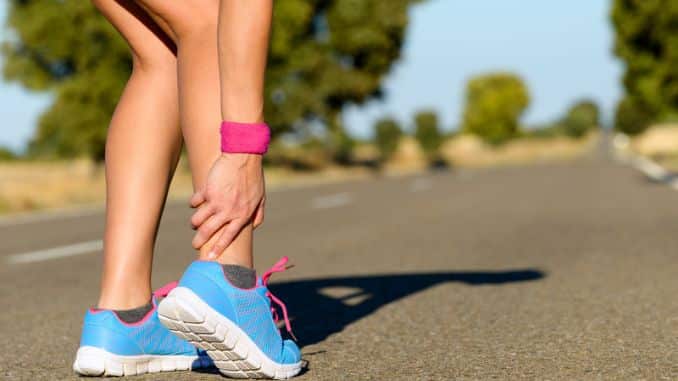
Research has shown that a lack of ankle mobility can increase rotational torque at the knee. This falls right in line with the joint-by-joint school of thought regarding training; if you lock up a joint that should be mobile, the body will look elsewhere to create that range of motion. This lack of ankle mobility may also negatively affect knee function.
This applies to what happens to the lumbar spine during squatting in a person with an ankle (or hip) mobility deficit. If someone can’t get good dorsiflexion (or hip flexion and internal cycle), he’ll look to the lumbar spine to get that range of motion by rounding (lumbar flexion). We know that merging lumbar flexion with compressive loading is a big-time no-no. So it’s essential to realize that folks with many ankle mobility restrictions may need to modify or eliminate squatting altogether.
Ankle Mobility on Olympic Lifters
Take, for example, Olympic lifters who wear traditional Olympic lifting shoes with big heel lifts. This artificially created ankle mobility allows them to squat deeper. While I’m not a massive fan of this footwear for regular folks for squatting, used sparingly, it’s not a big deal.
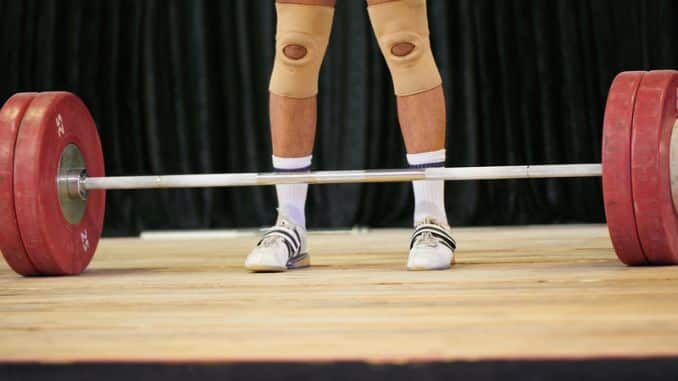
Other individuals may be better served with hip dominant squat deviations (e.g., box squats) that allow them to sit back and not squat quite as deep. At the same time, they work to improve their ankle mobility and get closer to squatting deeper (with more dorsiflexion). With these individuals, we supplement the more hip-dominant squatting with extra single-leg work and plenty of deadlift variations.
The take-home message is that ankle mobility has some far-reaching implications, and it’s essential to assess it to determine if it’s the factor limiting someone’s safe and efficient movement.
For more information on how to assess and address ankle mobility, check out Assess and Correct.
– Eric Cressey
Thank you so much, Eric. Great blog post with fantastic info. I can’t wait to get 14 hours of that kind of information. See you at the Fitness & Rehab Conference on March 27 & 28 at Vancouver College. CLICK HERE for details.
If you are looking for other blog posts on ankle injuries, check out:
- Why Your Ankle Exercise Rehab Program is Not Helping Your Clients
- The Best Hiking Stretch to Prevent Ankle & Knee Injuries – Heel Drop
- Ankle Injuries & Exercise with Jimmy Smith
Rick Kaselj, MS