
I have had a few clients with shoulder pain recently, so I decided to sit down and write a little about shoulder pain.
I wanted to put something together that I could print out and give to them so I could educate them on their shoulder pain.
This is the first part of the shoulder pain series – What causes shoulder pain?.
Enjoy!
How Big of a Problem is Shoulder Pain?
In 2006, there were 132 million physician visits for musculoskeletal disorders, the second most common reason (American Academy of Orthopaedic Surgeons, 2009).
Musculoskeletal health problems cost the United States nearly $850 billion annually, resulting in about 440 million lost work days.
With about 7.5 million physician visits yearly, shoulder pain significantly contributes to the increasing disability caused by musculoskeletal disorders in developing nations (AAOS, 2009).
I always like to start with some numbers. The numbers are impressive. It shows how big of an issue injuries are, especially shoulder pain.
4 Key Parts to the Shoulder
The shoulder girdle comprises three bones and three main joints held together by ligaments (structures that connect bones to other bones), tendons (structures that connect muscles to bones), bursae, and muscles.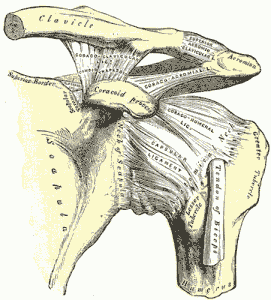
1. Bone of the Shoulder Joint
The Shoulder consists of these three bones:
- humerus (upper arm bone)
- scapula (shoulder blade)
- clavicle (collar bone)
2. Joints of the Shoulder
- Acromioclavicular Joint – is an essential structure on the outer end of the scapula, protruding away from the midline of the body. The acromion forms the highest point of the Shoulder. It is a crucial area for ligaments to attach and forms half of the acromioclavicular Joint with the clavicle.
- Glenohumeral Joint – is formed by the glenoid fossa on the scapula accepting the head or ball of the humerus. This is the main Joint of the Shoulder and the Joint that allows the high level of movement the Shoulder has.
The wide head of the humerus sits over a shallow glenoid fossa, providing excellent joint movement at the cost of decreased shoulder stability and increased risk of injury.
The glenoid fossa is made more profound by a ring of fibrous cartilage surrounding the glenoid, called the labrum. Extending and making the fossa deeper enhances the stability of the shoulder joint.
- Sternoclavicular Joint – is formed by the connection of the inner end of the clavicle to the sternum (breastbone). This joint is the only link of the Shoulder and arms to the rest of the body’s skeleton.
- Scapulothoracic Joint – is where the scapula moves up and down against the rib cage. This joint is not an actual joint as it depends entirely on the surrounding muscles during shoulder movements.
This shows that the Shoulder is a very complex structure. One specific Shoulder joint may be injured, but it will affect all of the other shoulder joints.
3. Muscles of the Shoulder
- Rotator Cuff Muscles – An essential set of muscles that stabilizes the Shoulder joint are the rotator cuff muscles which have a crucial function of keeping the humeral head centered within the glenoid fossa. The tendons of supraspinatus, infraspinatus, teres minor, and subscapularis muscles form the rotator cuff. Injuries involving the rotator cuff and its tendons are one of the leading causes of shoulder pain.
- Scapular Stabilizers – These are a group of muscles that aid in maintaining and moving the scapula.
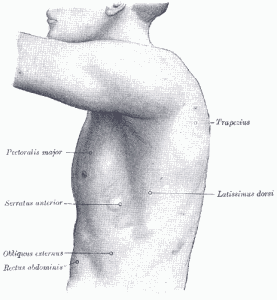
- Shoulder Muscles – These are the large superficial muscles you see when looking at the shoulder joint. Examples of these muscles are the deltoid and latissimus dorsi.
4. Bursae of the Shoulder
Bursae are fluid-filled sacs that allow smooth gliding between two surfaces that move against one another. There are many bursae associated with the shoulder joint.
The bursae between the acromion and joint capsule and the subscapularis and joint capsule are the most prone areas in the Shoulder to develop shoulder bursitis and pain because of inflammation.
6 of the Most Common Shoulder Injuries
Any injury or disease affecting the supportive structures of the Shoulder, such as the bones, tendons, bursae, cartilage, and ligaments, can result in shoulder pain.
In general, wear and tear, overuse or repetitive overhead movements, and trauma play a significant role in developing shoulder pain. The following are the common causes of shoulder pain:
#1 – Rotator Cuff Tendonitis
Tendonitis is the inflammation of the rotator cuff tendon resulting from overuse or repetitive movements affecting the rotator cuff.
#2 – Rotator Cuff Tear
 Overuse, repetitive overhead motions, aging, or falling may result in degeneration of the rotator cuff tendon, which can cause incomplete or complete tearing of the rotator cuff.
An injured rotator cuff may cause pain in the deltoid muscle when raising the arm from the side.
#3 – Shoulder Instability
The Shoulder becomes unstable when the humeral head falls out of the center of the glenoid fossa.
If the joint becomes too loose, the head of the humerus may slide partially out of place, termed shoulder subluxation, or it may ultimately come out of business, a condition called shoulder dislocation.
#4 – Frozen Shoulder or Adhesive Capsulitis
A frozen Shoulder is a tightening of the capsule that surrounds the shoulder joint, leading to poor shoulder movement and shoulder pain.
#5 – Shoulder Impingement
Shoulder impingement (squeezing of the rotator cuff tendon) most frequently occurs in the supraspinatus, underneath the bony arch of the acromion.
#6 – Arthritis of the Shoulder
Arthritis is a degenerative disease that usually occurs due to the wearing and tearing of the affected joints, as in osteoarthritis or systemic inflammation, as in rheumatoid arthritis. Shoulder joint cartilage loss causes pain and limited movement, resulting in arthritis.
Other causes of shoulder pain include shoulder fractures, labral tears, calcific tendonitis, superior labrum from anterior to posterior or SLAP tears, and biceps tendon ruptures.
Common Causes of Shoulder Pain
- Increased Risk with Age – Shoulder pain is more common in individuals older than 40 years and is often the result of wear and tear on the Shoulder.
- Previous Shoulder Injury – Younger adults often experience shoulder pain due to an earlier injury.
- Related to Sports Played or Work Performed – About 21% of shoulder pain associated with injuries was told to work (Wofford, Mansfield & Watkins, 2005).
Athletes and workers who execute repetitive overhead or throwing motions have a greater risk for shoulder injuries and pain. Swimming, tennis, baseball, volleyball, and javelin are sports where athletes have a greater chance of shoulder pain. Examples of occupations at greater risk of shoulder pain are carpenters, painters, construction workers, and workers performing repeated overhead movements.
 Posture – Bad postures and body mechanics also increase the risk of shoulder pain. For example, forward-rolled shoulders increase the risk for impingement syndrome. This type of posture can reduce the space the rotator cuff tendons or muscles go through, which increases the risk of squeezing the structures underneath the acromion.
Diagnosis of Shoulder Pain
The medical history, physical examination results, and diagnostic imaging tool findings mainly determine the cause of shoulder pain.
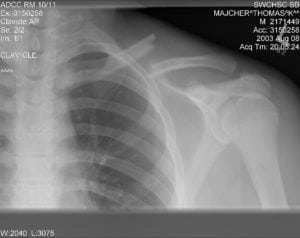
If the pain is severe or the cause is still undetermined thorough physical examination, your physician may recommend diagnostic imaging tests to obtain the precise cause of the pain. X-rays, magnetic resonance imaging, or an ultrasound may be ordered to provide better clarification of the injury and the severity of the damage.
I hope you enjoyed part one on Shoulder Pain and have a better idea of the magnitude of shoulder pain, the make-up of the Shoulder, common causes of shoulder pain, and ways of diagnosing shoulder pain.
Rick Kaselj, MS
P.S. – If you are looking for other resources when it comes to shoulder pain, injuries, and recovery, these may help:
Other articles on shoulder pain, injuries, and healing:
- Posture and Scapular Muscles
- Focus on Scapular Muscles
- Buns and Shoulder Pain
- Bench Press Shoulder Pain
- Getting the Most from Your Scapular Exercises
Fitness Education Courses on shoulder pain, injuries, and recovery:
Books and products related to shoulder pain, injuries, and recovery:
 |
|