


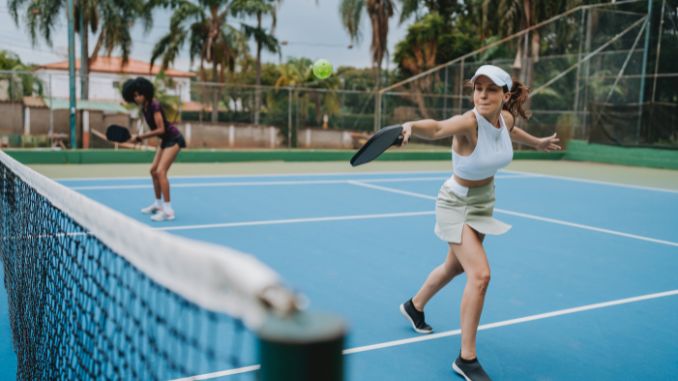
If you’re over 40 and love pickleball, you’ve likely noticed a shift.
Your body still performs, but recovery takes longer. Stiffness lingers, and small aches, particularly in the elbows, shoulders, or hips, become more frequent. Research on aging and physical function [1] suggests that changes in muscle quality, mobility, and overall physical capacity can affect how the body performs and tolerates physical activity over time (McGregor et al., 2014).
This does not mean you need to stop playing. It usually means you need a better system to support how your body now warms up, moves, and recovers.
If staying active without pain is the goal, focusing on Pickleball Injury Prevention for Over 40 becomes essential right from the start.
👉 Keep reading, there’s a simple way to make this easier on your body.
Why Small Aches Turn Into Bigger Problems
Most pickleball-related issues do not appear all at once. More often, they build gradually.
Mobility decreases, making movement less efficient, while the frequency of play remains the same or even increases. Meanwhile, recovery habits don’t keep up, creating a mismatch between the load on the body and its ability to recover. The International Olympic Committee’s consensus statement on training load and injury risk highlights poor load management as a major risk factor for injury. (Soligard et al., 2016).
In practical terms, it is often not just the sport itself that causes the problem. It is the combination of repeated play, limited mobility, incomplete recovery, and inconsistent preparation.
👉 The good news? A few small changes can make a big difference.
The Missing Piece: A Simple Weekly System
Instead of reacting to pain after it builds up, the goal is to stay ahead of it.
For pickleball players over 40, the most effective approach is usually not more intensity. Its structure and consistency. A simple weekly system should include:
- A proper warm-up before play.
- Mobility work between sessions.
- Recovery work after playing.
- Consistent injury-prevention habits.
That kind of approach helps improve readiness, reduce accumulated stress, and support better long-term durability.
1. Smart Warm-Ups (Before You Play)

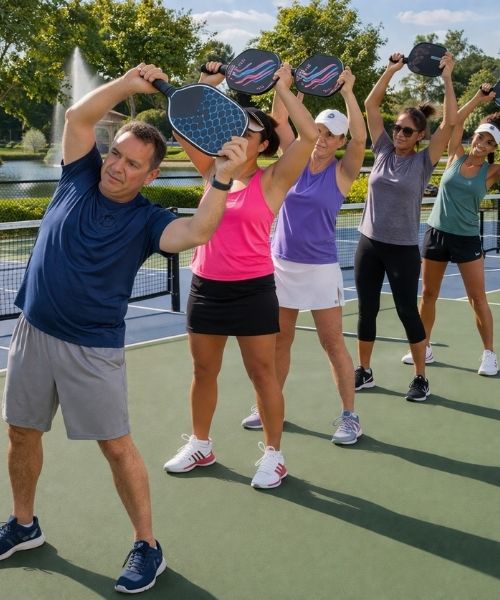
Jumping into play without preparation is one of the fastest ways to create unnecessary strain, especially in the elbow and shoulder.
Research reviewing the effects of stretching [2] on performance suggests that dynamic stretching can help maintain or improve performance, while prolonged static stretching immediately before activity may reduce it (Behm & Chaouachi, 2011).
Focus on:
- Arm circles and shoulder activation.
- Wrist circles and forearm stretches for prep.
- Hip mobility drills.
- Thoracic rotation.
- Light footwork and lateral movement.
The goal is simple: prepare your body for speed, rotation, and repetition before the first rally.
2. Mobility Work (Between Sessions)
Mobility loss is one of the most overlooked contributors to stiffness and discomfort.
Age-related changes in muscle quality and function are associated with reductions in mobility and physical performance over time (McGregor et al., 2014). When mobility declines in key areas, movement efficiency may also decrease, which can place more stress on surrounding joints and tissues during repeated play.
Key areas to focus on:
- shoulders and elbows
- thoracic spine
- hips
- ankles
You do not need long sessions. Short, consistent mobility work is often more realistic and easier to maintain.
3. Recovery (After You Play)
Recovery is not just downtime. It helps the body restore function after play and better prepare for future activity.
Helpful recovery strategies can include:
- Light movement, such as walking and gentle cycling.
- Gentle mobility work, such as gentle stretching or yoga.
- Hydration and sleep.
- Soft tissue work, such as foam rolling and massage.
Consistent recovery habits play a big role in Pickleball Injury Prevention for Over 40, helping reduce soreness and improve how the body responds between games.
A 2019 meta-analysis found that self-myofascial techniques may provide small but meaningful benefits for flexibility and muscle soreness [4], making them a practical option for players looking to reduce post-play stiffness (Wiewelhove et al., 2019).
4. Injury-Proofing Habits
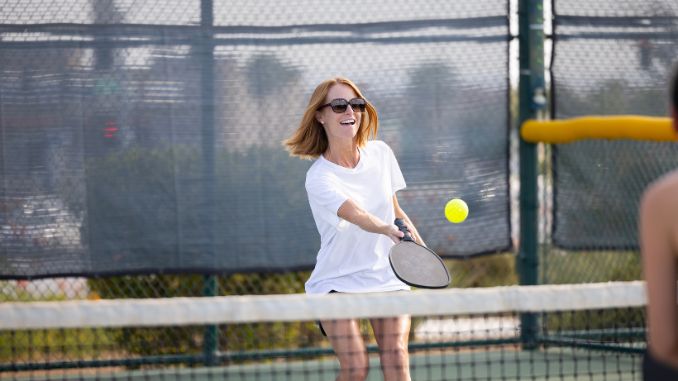
No routine can guarantee you will never get hurt. But consistent habits can reduce the likelihood that minor issues develop into more persistent problems.
For most players over 40, injury-proofing means:
- Warming up before every session.
- Maintaining mobility in key joints.
- Recovering intentionally with proper hydration, sleep, and soft tissue work.
- Avoiding sudden spikes in play volume.
- Responding early to warning signs.
This aligns with load-management research showing that rapid increases in load [3] relative to an athlete’s preparedness increase injury risk, while gradual and well-managed loading can be protective(Soligard et al., 2016).
What This Looks Like in Real Life
When you apply this system consistently, the changes are noticeable:
- Feel looser at the start of games.
- Recover faster between sessions.
- Experience less lingering stiffness.
- Build more confidence in your movement.
This is not about playing less. It is about being able to play consistently with fewer setbacks.
👉 By the end of this article, you’ll have a clearer plan for staying comfortable on the court.
Start With the Easiest Win
If you’re not sure where to begin, start with recovery.
A simple post-play recovery routine can be one of the easiest ways to reduce stiffness, ease soreness, and help your body feel better between sessions. Consistent recovery habits also make it easier to stay active without carrying discomfort from one game into the next.
The Bottom Line
You do not have to accept aches, stiffness, or slower recovery as the price of playing after 40. A better warm-up, regular mobility work, smarter recovery habits, and more sensible load management can help you stay more comfortable and more consistent on the court. The evidence suggests that while physical capacity changes with age, it remains adaptable with the right approach (McGregor et al., 2014).
Long-term progress comes from small habits, and Pickleball Injury Prevention for Over 40 is what allows players to stay active, mobile, and confident on the court.
Grab your free guide and start building a recovery routine you can stick to.
FAQs
1. Why does pickleball feel harder on my body after 40?
As you get older, mobility, recovery, and physical capacity can change. That can make repeated play feel more demanding, especially if you are not warming up or recovering consistently.
2. What is the best warm-up before pickleball?
A dynamic warm-up is usually best. Focus on light movement such as brisk walking or easy jogging, shoulder activation, hip mobility, and simple footwork drills to help prepare your body before you play.
3. How can I recover better after pickleball?
Start with simple recovery habits like light movement such as walking or gentle cycling, mobility work, hydration, and enough rest. A consistent post-play routine can help reduce stiffness and soreness between sessions.

1. McGregor, R. A., Cameron-Smith, D., & Poppitt, S. D. (2014). It is not just muscle mass: A review of muscle quality, composition and metabolism during ageing as determinants of muscle function and mobility in later life. Longevity & Healthspan, 3(9). https://doi.org/10.1186/2046-2395-3-9
2.Behm, D. G., & Chaouachi, A. (2011). A review of the acute effects of static and dynamic stretching on performance. European Journal of Applied Physiology, 111, 2633–2651. https://doi.org/10.1007/s00421-011-1879-2
3.Soligard, T., Schwellnus, M., Alonso, J.-M., Bahr, R., Clarsen, B., Dijkstra, H. P., Gabbett, T., Gleeson, M., Hägglund, M., Hutchinson, M. R., Janse van Rensburg, C., Khan, K. M., Meeusen, R., Orchard, J. W., Pluim, B. M., Raftery, M., Budgett, R., & Engebretsen, L. (2016). How much is too much? (Part 1) International Olympic Committee consensus statement on load in sport and risk of injury. British Journal of Sports Medicine, 50(17), 1030–1041. https://doi.org/10.1136/bjsports-2016-096581
4. Wiewelhove, T., Döweling, A., Schneider, C., Hottenrott, L., Meyer, T., Kellmann, M., Pfeiffer, M., & Ferrauti, A. (2019). A meta-analysis of the effects of foam rolling on performance and recovery. Frontiers in Physiology, 10, Article 376. https://doi.org/10.3389/fphys.2019.00376