
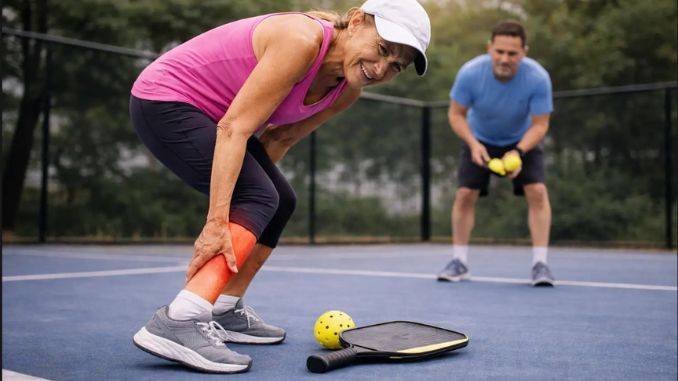
If you’ve ever walked off the pickleball court thinking…
“Why do my calves feel like rocks?”
“Why is my Achilles so stiff the next day?”
You’re not imagining it.
And more importantly, you’re not doing anything wrong
Your body just isn’t fully prepared for the specific demands yet.
This is something we see all the time with pickleball players.
People who love the game…
People who feel great while playing…
And then later tight, sore, stiff lower legs that just don’t bounce back like they used to.
Let’s talk about why that’s happening and what you can do about it so you can keep playing the game you enjoy.
👉 Stick with me until the end. I’ll walk you through a simple way to start easing this tightness so you can feel better on and off the court.
First, Let Me Reassure You…
This tightness in your calves and Achilles?
It’s not just “getting older.”
It’s not something you have to push through.
And it’s definitely not something you should ignore.
Your body is simply telling you:
“Hey — I need a little more support for what you’re asking me to do.”
Why Pickleball Is Tough on Your Lower Legs
Pickleball doesn’t look intense from the outside. But your body feels something very different.
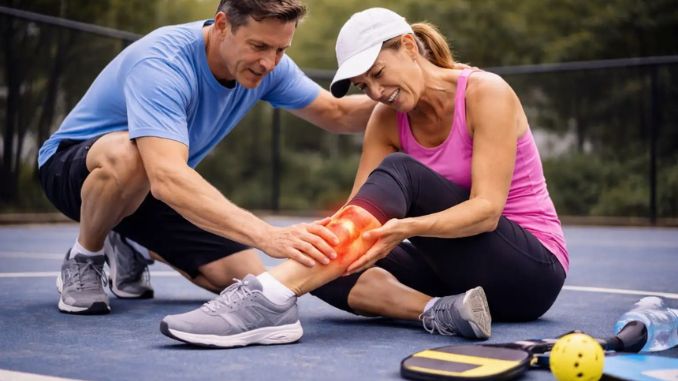
1. You’re Constantly Starting and Stopping
Think about how you move during a game:
- Quick steps forward
- Sudden stops
- Small bursts to reach the ball
Every one of those movements puts stress on your calves and Achilles.
Your Achilles tendon is repeatedly loaded during quick starts, stops, and push-offs
2. You’re Pushing Off More Than You Realize
Every time you:
- Move toward the kitchen
- Chase a shot
- React quickly
You’re repeatedly loading your lower leg.
And here’s the thing most people don’t realize: it’s not just how hard you push, it’s how often you do it. Tendons respond to cumulative loading, and repeated submaximal load without enough recovery can contribute to overload and stiffness [5] (Cook & Purdam, 2009; Malliaras et al., 2013).
That repeated demand can leave your calves feeling tight and your Achilles feeling stiff.
3. The Problem Isn’t Just in Your Calves
This is something I wish more players understood.
Your calves don’t work alone.
If your:
- Hips are tight
- Hamstrings are stiff
- Glutes aren’t doing their job
Your calves end up picking up the slack.
So even though you feel it in your lower legs…
The issue often comes from how your body is moving as a whole.
4. You Might Be Doing “Too Much, Too Soon.”
We see this all the time:
- You start playing more often
- You feel good, so you keep going
- Then suddenly… tightness shows up
That’s not failure — that’s overload without enough recovery.
Your body just hasn’t had time to adapt yet, and tendon tissues generally respond best when loading increases progressively [3] rather than suddenly (Malliaras et al., 2013).
The Truth About Stretching (That Most People Miss)
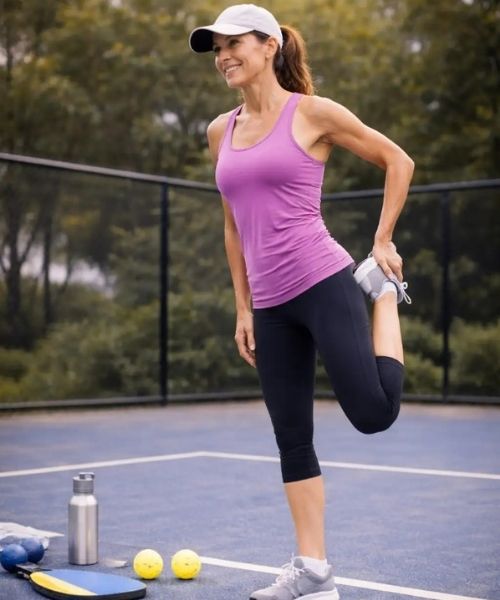
👉 Quick note — before you move on, make sure you don’t skip the final section, because that’s where most players finally connect the dots and start seeing real relief.
Most people respond by doing this:
Stretch the calves more.
And yes — that can help a little.
But if that’s all you’re doing, you’re only addressing part of the problem.
Because tightness isn’t just about “short muscles.”
It’s about:
- Load
- Strength
- Movement
- Recovery
That’s why stretching alone often doesn’t solve it. Loading-based rehab plays a central role in improving tendon function and tolerance (Malliaras et al., 2013).
The Fix (What Actually Helps)
Let’s keep this simple and practical.
1. Help Your Ankles Move Better
If your ankle is stiff, your calf works overtime.
Gentle mobility work can take pressure off your lower leg. Here’s a simple way to do it:
- Stand facing a wall or sturdy chair, with one foot a few inches back and your heel flat on the floor.
- Keep your foot pointing straight ahead, then gently drive your knee forward over your toes.
- Go only as far as you can without your heel lifting or pain increasing, then pause for 1–2 seconds.
- Return to the start and repeat for 8–10 repetitions, then switch sides. Do 1–2 sets.
Move slowly and smoothly — this should feel like a gentle mobility drill, not a hard stretch.
2. Build Strength (This Is a Big One)
Your Achilles is strong, but it needs to be prepared for the loads you’re placing on it.
Progressive calf loading programs, [4] including eccentric and heavy slow resistance work, are commonly used to improve Achilles pain and function [1] (Alfredson et al., 1998; Beyer et al., 2015).
Simple things like:
- Controlled calf raises — 2 sets of 10 repetitions.
- Heel drop (eccentric work)— 2 sets of 10 repetitions.
- Bent-knee calf exercises — 2 sets of 10 repetitions.
Can make a huge difference in how your legs feel after playing.
3. Warm Up With Intention
I know — it’s tempting to just jump into a game.
But your lower legs need a quick “heads up.” Even a brief warm-up with light movement and progressive muscle activation can help prepare the body for activity [6] (Nelson et al., 2007).
Even 3–5 minutes of:
- Light movement (such as easy walking, marching in place, or a gentle jog)
- Gentle activation (such as calf raises, heel-to-toe rocks, or mini squats)
- Dynamic stretches (such as ankle circles or leg swings)
It can help your lower legs feel more ready for play. General exercise guidance for older adults includes aerobic movement, strengthening, and flexibility work as part of a balanced routine (Nelson et al., 2007)
4. Look Beyond Your Calves
This is where a lot of people get stuck.
If you only focus on your calves…
you miss the bigger picture.
Working on the hips and other nearby muscle groups can help improve lower-extremity mechanics [2] and reduce the amount of compensation happening farther down the chain (Powers, 2010)
Working on:
- Strengthening your glutes and hamstrings
- Strengthening and stretching your hips
It helps take pressure off your lower legs.
5. Give Your Body Time to Adapt
You don’t have to stop playing.
But you do want to be mindful of:
- How often you play
- How your body feels after
Sometimes the smartest move is simply adjusting your volume so your body can keep up with you.
You Don’t Have to Figure This Out Alone

If you’re dealing with tight calves or Achilles stiffness after pickleball…
You don’t need to guess what to do next.
We’ve put together a simple, step-by-step guide to help you:
- Reduce lower-leg tightness
- Move more comfortably on the court
- Feel less stiff after your games
You can claim your free guide here:
One Last Thing
If your calves or Achilles have been bothering you…
Don’t ignore it.
But also don’t assume it’s something serious or permanent.
Most of the time, it’s just your body asking for:
- Better preparation
- Better support
- Better balance
And once you give it that… things can improve faster than you expect.
FAQs
1- Why do my calves feel so tight after pickleball?
Pickleball involves lots of quick stops, starts, and push-offs, which can repeatedly load your calves and lower legs
2- Why does my Achilles feel stiff the day after playing?
Your Achilles can get stiff after repeated loading, especially if your body is not fully adapted to the volume or intensity of play yet.
3- Is calf tightness after pickleball normal?
It is common, but it should not be ignored if it keeps happening or starts getting worse.
4- Will stretching alone fix tight calves and Achilles tightness?
Stretching may help a little, but strength, mobility, recovery, and load management are usually important too.
5- What helps reduce calf and Achilles tightness after pickleball?
A mix of ankle mobility work, calf strengthening, a short warm-up, and gradually building your playing volume can help.