

If you’re new to strength training and looking for a simple, effective, and versatile tool to kickstart your fitness journey, kettlebells are one of the best choices you can make. Originally used in 18th-century Russia as a way to measure crops, these cannonball-shaped weights with a top handle have become a staple in modern fitness — and for good reason.
Kettlebells allow you to perform a wide range of exercises that build strength, burn fat, improve endurance, and enhance mobility — all at the same time.
Beginner Kettlebell Workout
Kettlebell training [1] shows potential for improving physical function and strength.
According to Anthony J. Wall, Senior Director of Professional Education at the American Council on Exercise (ACE), beginners should focus on mastering proper kettlebell technique before increasing the load or complexity of their workouts. He emphasizes, “Correct technique is critical. Don’t let the urge to start with a heavy weight compromise your form. Perfect your technique first.”
1. Kettlebell Deadlift (Strength Foundation)
Muscles worked: Glutes, hamstrings, lower back, core
Begin in an upright standing position with your feet shoulder-width apart, maintaining good alignment with your head, shoulders, hips, and legs. Engage your core. Place a kettlebell on the floor between your feet. Hinge at your hips — not your knees — and lower your upper body forward while keeping your back flat. Grasp the kettlebell handle firmly with both hands. Push through your heels and extend your hips to return to the upright standing position. Repeat the movement for 3 sets of 8–10 repetitions.
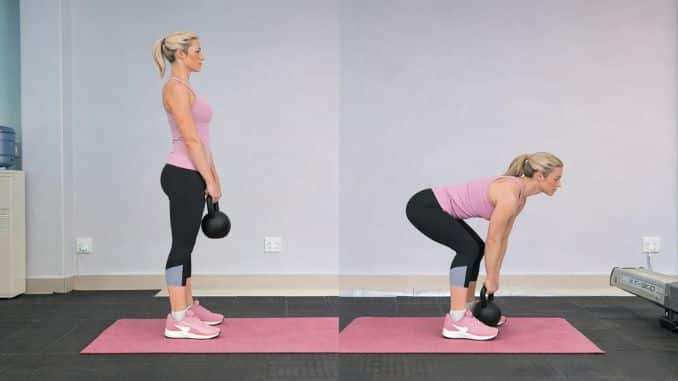
✅ Why it’s great: Builds hip strength and teaches the essential hip-hinge pattern used in most kettlebell exercises.
2. Kettlebell Swing (Power & Conditioning)
Muscles worked: Glutes, hamstrings, core, shoulders
Begin in an upright standing position with your feet shoulder-width apart, maintaining good alignment with your head, shoulders, hips, and legs. Place the kettlebell about a foot in front of you on the floor. Engage your core, hinge at your hips, and grasp the kettlebell handle with both hands. Hike the kettlebell back between your legs while keeping your back flat and chest lifted.
Drive your hips forward explosively to swing the kettlebell up to chest height, allowing the power to come from your hips — not your arms. Let the kettlebell swing back down naturally between your legs, maintaining control of the movement. Repeat the exercise for 3 sets of 10–12 repetitions.
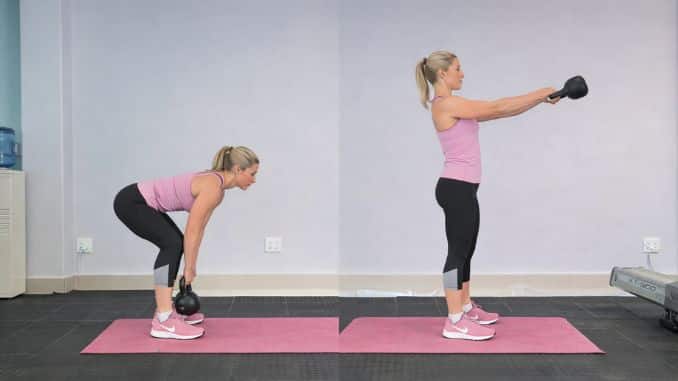
✅ Why it’s great: Boosts power, improves cardiovascular fitness, and strengthens your posterior chain.
3. Kettlebell Goblet Squat (Lower-Body Strength)
Muscles worked: Quads, glutes, hamstrings, core
Begin in an upright standing position with your feet slightly wider than shoulder-width apart, maintaining good alignment with your head, shoulders, hips, and legs. Hold a kettlebell close to your chest by the horns, keeping your elbows pointing down. Engage your core and keep your chest lifted.
Bend your knees and hips to lower your body into a squat position, aiming to bring your thighs parallel to the floor or slightly below while keeping your back straight. Make sure your knees track over your toes and do not cave inward. Press through your heels to return to the starting position. Repeat the movement for 3 sets of 10–12 repetitions.
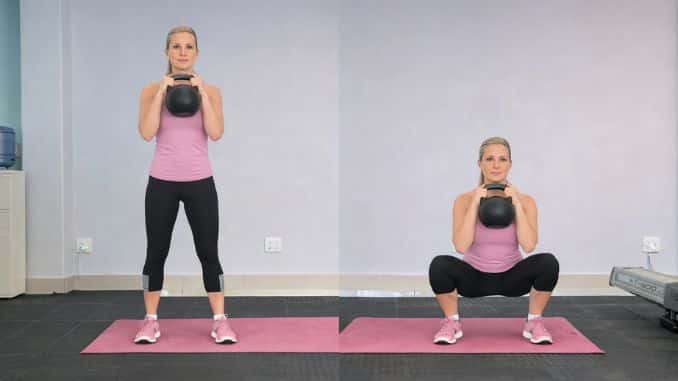
✅ Why it’s great: Builds leg strength, improves squat mechanics, and engages the core for stability.
4. Kettlebell Press (Upper-Body Strength)
Muscles worked: Shoulders, triceps, core
Begin in an upright standing or half-kneeling position with your feet hip-width apart, maintaining good alignment with your head, shoulders, hips, and legs. Hold a kettlebell at shoulder height with one hand, palm slightly inward, wrist in neutral, bell resting against the forearm, and keep your core engaged. Press the kettlebell overhead by extending your arm fully until your elbow is straight and the weight is stacked over your shoulder. Keep your torso stable and avoid leaning backward. Slowly lower the kettlebell back to shoulder height with control. Repeat the movement for 3 sets of 8–10 repetitions on each side.
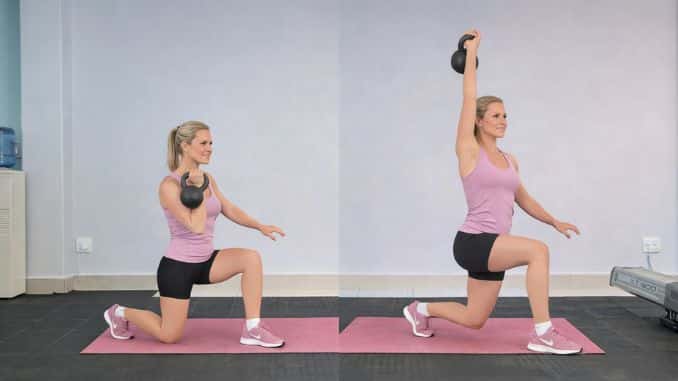
✅ Why it’s great: Develops shoulder and arm strength while improving overhead stability.
5. Kettlebell Row (Back & Posture)
Muscles worked: Lats, rhomboids, biceps, core
Begin in a standing position with your feet hip-width apart, maintaining good alignment with your head, shoulders, hips, and legs. Hold a kettlebell in one hand with your arm extended toward the floor. Hinge forward slightly at your hips while keeping your back flat and core engaged, placing your opposite hand on your thigh or a stable surface for support.
Pull the kettlebell upward toward your ribcage by driving your elbow back, keeping it close to your body throughout the movement. Squeeze your shoulder blades together at the top, then slowly lower the kettlebell back to the starting position with control. Repeat the movement for 3 sets of 10–12 repetitions on each side.
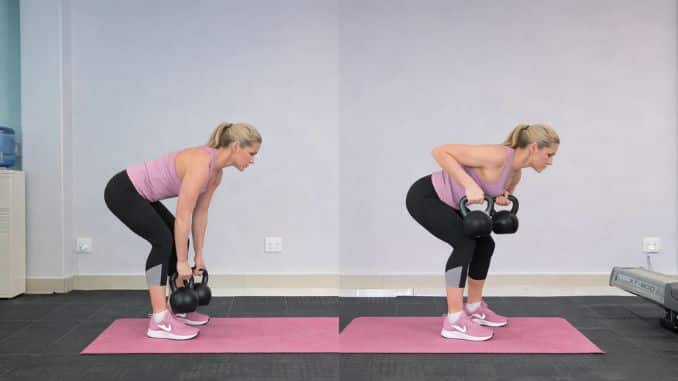
✅ Why it’s great: Strengthens your back and improves posture, balance, and pulling strength.
6. Kettlebell Halo
Muscles worked: Shoulders, upper back, core
Stand with your feet hip-width apart, holding one kettlebell upside down by the horns. Keeping your core tight, slowly circle the kettlebell around your head, keeping it close to your neck as if drawing a “halo.” Switch directions after each set. Repeat the movement for 3 sets of 8-10 repetitions per direction.
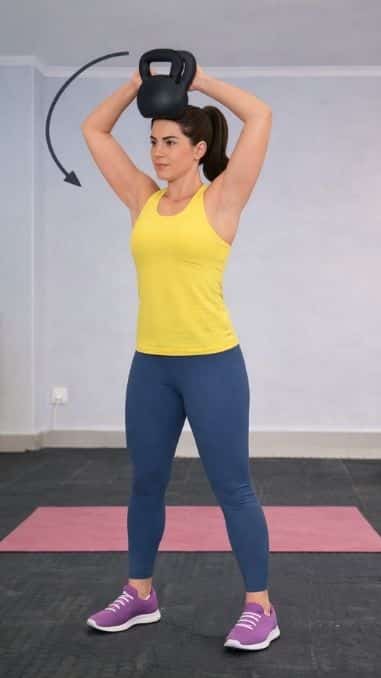
✅ Why it’s great: The kettlebell halo improves shoulder mobility, strengthens stabilizing muscles, and supports better performance in overhead lifts and other exercises.
Benefits of Kettlebell Training
- Full-Body Workout: Kettlebell exercises engage multiple muscle groups at once, helping you build overall strength, power, and endurance in less time.
- Upper-Body Strength & Stability: Movements like the kettlebell swing and overhead press strengthen your shoulders, arms, and core while improving posture and joint stability.
- Lower-Body Power: Exercises such as the goblet squat build strong legs and glutes, while the kettlebell deadlift targets the posterior chain, including the back, glutes, and hamstrings.
- Works Strength and Cardio Together: [2] Kettlebell training helps improve both your muscle strength and heart health at the same time. It’s a great option if you want to build power, increase endurance, and boost aerobic capacity without needing lots of equipment.
- Fat Burning & Weight Loss: Kettlebell training is highly effective for burning calories, reducing body fat, and improving body composition.
- Functional Strength & Performance: Consistent training improves coordination, mobility, and real-world strength, enhancing overall athletic performance and daily movement.
- Can improve postural control,[3] helping with stability and coordination. (3)
- Improved Quality of Life: Regular kettlebell workouts contribute to better posture, increased energy, and a stronger, more resilient body.
Common Mistakes to Avoid
- Choosing the wrong weight: Too heavy or too light can hurt your form and progress.
- Poor posture [4]: Rounding your back or leaning during weight lifting increases injury risk. (4)
- Skipping technique: Especially with exercises like the kettlebell overhead press or snatch, bad form leads to injury.
- Overtraining: Without rest, your body can’t grow stronger.
- Ignoring mobility: Movements like the kettlebell halo can help prevent shoulder issues and improve range of motion.
Conclusion
Kettlebell training is one of the most effective and versatile ways to build strength, endurance, and full-body fitness — even with just one kettlebell. By mastering fundamental movements like the kettlebell squat, kettlebell overhead press, and kettlebell halo, beginners can progress quickly and safely toward their fitness goals.
Start with a beginner kettlebell workout, focus on good form, and steadily challenge yourself with heavier weights and more complex movements. Over time, you’ll not only gain strength but also improve your cardio fitness, mobility, and everyday performance — all with one powerful training tool.
Frequently Asked Questions
1. What weight kettlebells should a beginner use?
Most beginners start with 8–12 kg (18–26 lbs) for women and 12–16 kg (26–35 lbs) for men. Go lighter for upper-body and overhead moves, and focus on proper form before increasing weight.
2. Can I lose belly fat with a kettlebell?
Kettlebell workouts help burn calories and support fat loss, but they can’t target belly fat alone. Best results come from combining kettlebell training with a healthy diet and regular cardio.
3. How long should a kettlebell workout be for beginners?
Begin with 15–20 minutes, 2–3 times per week. Focus on basic movements and good technique, then increase time or intensity as strength improves.
4. What happens if I do 100 kettlebell swings a day?
Doing 100 swings daily can improve strength, endurance, and calorie burn. Use proper form, allow recovery, and include other exercises for balanced training.