
The client’s shoulder impingement is a condition that can cause pain, weakness, and hard in lifting the arm. Rotator cuff exercises are needed to help your client recover from the injury.
What is Shoulder Impingement?
When you raise your unaffected arm to the side, the subacromial space narrows and measures about 6 to 14 millimeters.
What could cause your clients shoulder impingement is their rotator cuff. Let me explain how your rotator cuff could be the problem.
What is Rotator Cuff Impingement?
A rotator cuff is a group of muscles and tendons that help with shoulder movement. Rotator cuff impingement occurs when the rotator cuff tendons have passageways where they meet inside the shoulder joint. This can cause pain, reduced strength, and soft tissue swelling. Rotator cuff impingement causes pain when the cuff is pinched or squeezed inside the shoulder joint. 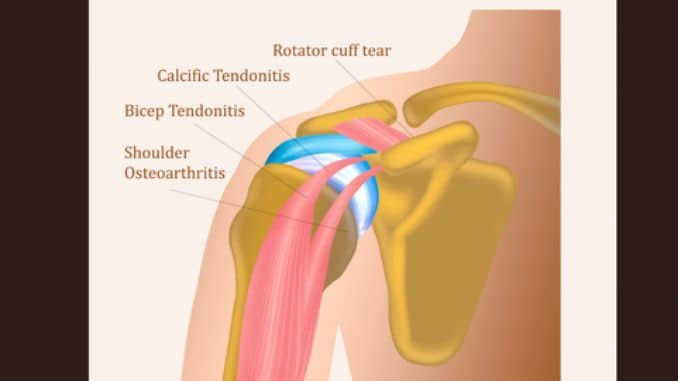
#1. Weak Rotator Cuff
If your client has weak rotator cuff muscles, they won’t be able to rotate the glenohumeral joint externally. This won’t prevent the greater nodule from moving out of the subacromial space, leading to the greater tuberosity compressing against the acromion and the contents in the subacromial area.
It is one of the reasons why you must focus on rotator cuff exercises that help improve your client’s rotator cuff strength.
#2. Tight External Rotation
Impingement at the glenohumeral joint occurs when a client has a limited external rotation range of motion because the greater tuberosity does not move out of the way during the abduction. A tight internal rotator is a reason for a decreased range of motion tightness.
It would help if you focused on all the tight muscles in the internal rotation of the glenohumeral joint. I go through this in The Most Effective Rotator Cuff Exercise Program.
#3. Posterior Capsule Tightness
Shoulder impingement can cause posterior capsule tightness, which results in the humerus rotating externally and altering the position of the greater tuberosity. Your clients with this issue must receive rotator cuff exercises and stretches to address this issue. If your client has shoulder impingement, you must focus on exercises and tries to keep the rotator cuff muscles and tendons healthy.
I go through all of this in the Effective Rotator Cuff Exercise Manual.
Rick Kaselj, MS

.